Across India’s factories, warehouses, and industrial plants, one machine silently drives productivity — the Vertical Reciprocating Conveyor (VRC), also known as a cargo or goods lift.
From transferring crates in a fishery’s cold storage to moving chemical drums in a pharma unit, to moving goods in a e-commerce warehouse these lifts keep India’s industries running round the clock.
But, if a lift fails, every minute lost isn’t just about operational downtime — it becomes a safety hazard. Manual handling, makeshift hoisting, or untrained workers trying to move loads in the absence of a functioning lift can lead to serious injuries and equipment damage. Safety is the f irst casualty of poor maintenance.
Unfortunately, in many industrial setups, lifts are used continuously but rarely optimized for the environment or workforce that operate them.
Datar Engineering & Consultancy Pvt. Ltd. takes a different approach — designing safety f irst, ergonomically efficient, and fully customized lifting systems that consider not just the machine, but the people around it.
For over two decades, Datar has engineered VRCs that withstand India’s real-world conditions — extreme heat, humidity, dust, combustible atmospheres, and continuous usage — often handled by under-skilled or contractual workforces.
Every lift is tailored for operator convenience, system efficiency, and long-term reliability.
At Datar, customization is not an upgrade — it’s a philosophy that ensures India’s industries operate safely, efficiently, and sustainably.
The Human Side of Industrial Efficiency
Behind every lift is a team of operators who work long hours managing loads, navigating t ight spaces, and depending on equipment they may not have designed, but must trust daily. For them, poor lift ergonomics means more than inconvenience — it means fatigue, risk, and loss of efficiency.
Datar’s engineering approach begins with empathy for these users, designing systems that make industrial work safer, simpler, and smarter.
Why One Size Never Fits All?
1. The Environment Shapes the Design
A lift designed for a pharma plant cannot serve in a fishery, and vice versa.
- Pharma environments demand explosion-proof or fire proof systems that resist chemical exposure, corrosion and prevent ignition.
- Fishery operations require corrosion and contamination proof materials.
- Heavy goods manufacturers, and the warehouses which has heavy goods or even normal goods in bulk quantities, need VRCs designed for their round the clock operations. Our customised lifts make their jobs easy.
Each setup demands its own safety logic — from machine guarding and interlocks to customized control systems — proving that “one size fits all” never works in material handling.
2. The Human Factor
Operators spend hours interfacing with these machines.If controls are placed inappropriately, or access too open, fatigue and incidents follow. In most Indian environments, human–machine interfaces aren’t designed for our workforce’s physical ecosystem — when they are, accidents reduce dramatically.
Datar’s ergonomic panels, fenced access points, and poka-yoke logic systems make everyday operation safe, intuitive, and fatigue-free.
3. The Maintenance Challenge
In India, VRCs often run 24/7 with little downtime. Over time, wear and tear, lack of lubrication, or vibration misalignments can cause operational difficulties and safety issues— early signs often ignored by operators. Continuing to use the lift without maintenance is a major safety error.
That’s why Datar integrates preventive maintenance into the design itself. Accessible lubrication points, quick-open service panels, and smart sensors allow early detection of stress or imbalance — keeping uptime high and hazards low.
Built for Safety — From Machine Guarding to Control Systems
Built for Safety — From Machine Guarding to Control Systems. Datar combines mechanical precision and electrical intelligence to ensure total protection from structure to circuit.
Key customizations include:
- Explosion and fire-proof electrical components for volatile environments — ensuring safety even if external ignition occurs.
- Machine-guardings and fenced service platforms with chequered floors to prevent slips and falls.
- Fingerprint and thermal scanners restricting operation to authorized personnel only.
- Poka-yoke logic systems, interlocks, and load sensors that prevent unsafe operation.
- Voltage surge detection and automatic emergency brakes that engage on overload or failure of lifting elements.
These aren’t mere compliance measures — they represent Datar’s core belief that safety and efficiency are inseparable.
The Datar Customization Process
Every project begins with a clear understanding of your site, material, environment, and workforce.
Step 1: Site Study & Requirement Mapping
Datar’s engineers visit your site to analyze floor levels, space availability, environmental conditions, and safety constraints. They also determine the type of load — whether size, chemical nature, nature of load surface and density concentrations— to design the right balance of structure, control, and capacity.
Step 2: Safety & Risk Assessment
Potential risks such as overloading, fatigue, or collisions are identified early and eliminated through poka-yoke design principles — not after installation.
Step 3: Concept Design & Simulation
Each lift undergoes 3D visualization and structural software simulations to test performance before fabrication. Mechanical engineers verify structural stability and load capacity, while electrical designers model control systems for precision and safety. if these electrical system models are rigorously tested for all forcible probabilities.
Step 4: Fabrication, Testing & Verification
Datar’s mechanical engineers ensure structural stability, finishing, and dimensional accuracy. Electrical technicians manufactures control systems customized to the client’s workflow.
Step 5: Installation
Our delegated teams make sure that the products customised and manufactured as per the clients requirement are installed with safety measures and protocols on the designated sites. We even make sure to do a test run and even make sure to guide the client in terms of the usage.
Step 6: Operator Training & Maintenance Integration
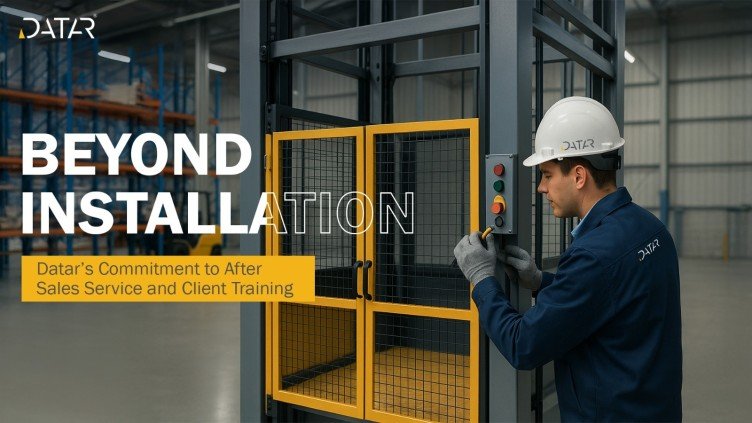
Before handover, Datar conducts on-site operator training covering daily inspection, maintenance, safety and emergency protocols — because a safe lift starts with an informed user.
Maintenance is Safety in Motion
A lift that runs continuously must also be maintained continuously. Maintenance, when done right, is not just mechanical upkeep — it’s safety through discipline.
Datar’s 24/7 operational philosophy includes:
- Preventive audits to check wear and tear, noise, and structural integrity.
- Smart lubrication schedules and corrosion checks suited to environment type.
- IoT-enabled monitoring for motor temperature, load stress, and run cycles.
- Quick-access design for minimal downtime during service.
- Digital maintenance logs and refresher training for operator accountability.
At Datar, maintenance isn’t an afterthought — it’s built into the soul of every design. It ensures both man and machine perform at their best, safely and sustainably.
Case Studies — Customization in Action
1. Pharma-Grade VRC
A leading pharmaceutical plant needed a lift to move chemical barrels safely between levels without contamination and spillage.
Datar’s Solution: Explosion-proof electrical systems and stainless-steel internal construction. Outcome: Zero corrosion risk, uninterrupted operations under strict audit environments.
Extended Example — Pharma Company (Coastal Region): Operating near the seashore with high humidity and rainfall, this pharma company relied on Datar’s stainless-steel components and corrosion-proof designs. Their VRCs have operated f lawlessly for over 20 years without replacement.
2. Fishery Cold Storage Lift
In a coastal fishery operating below freezing temperatures, regular lifts suffered lubricant thickening and motor failure.
Datar’s Solution:Customized low-temperature lubricating fluids, electrical system designed to operate at sub-zero temperatures.
Outcome: Continuous operation at –10°C, increased efficiency, and low maintainence.
3. E-commerce Warehouse VRC
E-commerce facilities operate 24×7, lifting hundreds of packages hourly. Workers often face fatigue due to manual handling and frequent downtime.
Datar’s Solution: Heavy-duty, ergonomically designed VRC’s with efficient control systems and advanced safety interlocks.
Outcome: Drastically reduced downtime and improved worker safety through high-volume operations.
Color and Aesthetic Adaptability
Beyond performance, Datar adapts lifts to align with each client’s brand and safety standards. According to company-specific safety codes, lifts are finished in branded color schemes that also ensure high visibility for worker awareness. Industrial design meets identity — without compromising safety.
The Engineering Behind Every Customization
Every Datar lift is a collaboration between two disciplines:
- Mechanical Engineering: Designs stables structures to suit load capacity.
- Electrical Engineering: Governs control logic, sensors, and interlocks.
Together, they ensure that every bolt, wire, and circuit serves a purpose — embodying the philosophy of safety and ergonomic human-first engineering.
Conclusion: Building Safe, Smart, and Sustainable VRCs for India
Every lift tells a story of the people it serves, the materials it moves, and the safety systems that protect both. In today’s industrial India, where uptime equals productivity, ergonomic and customized lifts are not a luxury, they are a necessity.
At Datar Engineering, every VRC is more than a mechanical structure — it’s a symbol of trust between engineering and empathy. Built to protect lives, enhance efficiency, and adapt to every environment — from requirement to reality, Datar lifts India safely and sustainably.